Hydrocele in Children
Treatment for fluid-filled scrotal swelling, often painless and typically harmless.
What is a hydrocele in children?
A hydrocele is a buildup of fluid in the thin pouch that surrounds the testicle in the scrotum. It appears as a smooth, painless swelling. Up to 1 in 10 newborn boys may have a hydrocele at birth, and many resolve without treatment during the first year of life.
Causes and types
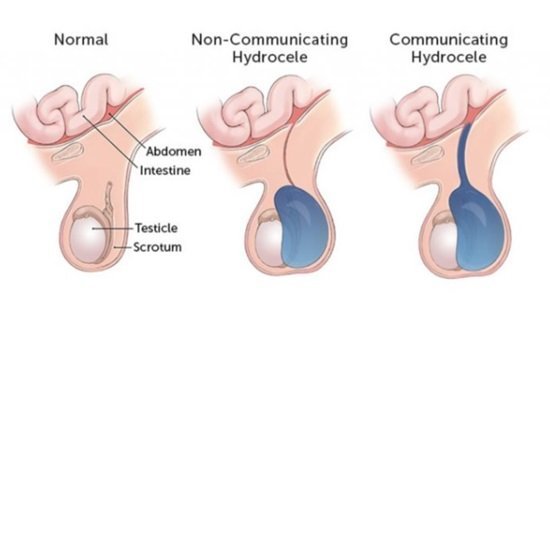
Before birth, the testes develop in the abdomen and move into the scrotum through a natural passage. Normally this passage closes. When it does not close completely, fluid can collect around the testicle.
- Communicating hydrocele — the passage remains open; fluid flows in and out, so swelling may change size during the day
- Noncommunicating hydrocele — fluid is trapped around the testicle; often present at birth and may resolve in the first year
- Hydrocele in older children may need further evaluation to rule out other conditions
Symptoms
- Smooth, soft swelling of the scrotum that is usually not painful
- Scrotum may appear smaller in the morning and larger later in the day (communicating type)
- No effect on urination in most children
- Symptoms may overlap with inguinal hernia — expert examination is important
Diagnosis
Our surgeons perform a careful physical examination. Ultrasound may be done to confirm the diagnosis and distinguish hydrocele from a hernia or other scrotal mass. Transillumination (shining a light through the scrotum) can help confirm fluid collection.
Treatment
A noncommunicating hydrocele in an infant often resolves on its own as the body reabsorbs the fluid. We may recommend observation with regular follow-up during the first 12–18 months.
A hydrocele that persists beyond 12–18 months, or a communicating hydrocele that does not resolve, often requires surgical correction (hydrocelectomy). Surgery involves draining the fluid and closing the passage to prevent recurrence. If a hernia is present, it is repaired at the same time.
What we offer
- Clinical evaluation & ultrasound
- Conservative & surgical options
- Communicating hydrocele care
- Safe anesthesia for children
When to contact us
- The swelling becomes firm, painful, or red
- Your child has fever or appears unwell
- The hydrocele grows rapidly or does not improve as expected
- You are unsure whether the swelling is a hydrocele or hernia
Key points
- Many newborn hydroceles resolve without surgery in the first year
- Persistent or communicating hydroceles may need hydrocelectomy
- Early evaluation prevents confusion with inguinal hernia
- Long-term outcomes after treatment are excellent in most children
